College - Merging Your Personal and Work Lives For freshmen, one of the biggest adjustments to college is contending with the inevitable merging of their personal and work lives. Suddenly you are living with your classmates, class is a seven minute walk from your dorm, and you see your professors in line at Starbucks.
There are five important boundaries I suggest setting as college freshmen to prevent your personal life from spilling into your student life, and your work from limiting the amount of fun you have in your free time. 1. With Your Roommate(s) Usually college freshmen have little to no say regarding who the school pairs them up with in a room for the first year. Sure, there's a survey asking if you're a neat freak, your preferred study environment, and if you are a night owl. I remember checking YES / QUIET / NO. And I ended up with a messy roommate who preferred studying at 1 am to music AND the television, with a few friends in the room.
But it wasn't a disaster, and here's why. After biting my tongue for a little while, I ventured into a real conversation about some room rules. We negotiated about containing our own messes to our areas, using headphones, and I stuck around more so that I was comfortable with her friends being over.
My suggestion is to have it out from day one. Just ask each other about pet peeves, preferences, and agree to divide up chores. If nobody ever thinks it's his job to take out the trash, you and your roommates will just keep piling it up in the tiny room trash can, until you have some precariously-balanced Mount Garbage situation on your hands. 2. With Your Parents Figure out how much space you need and talk with your parents about their expectations. If they want to hear from you, can you commit to a weekly phone call, and a few emails a week? If you live close to home, do they want you to come to dinner on Sundays? Conversely, do you want them to call before stopping by?
You're also allowed to set some boundaries regarding what they ask and how often they bring it up. For example, if you are not comfortable discussing the person you are dating, or you're sick of talking about your classes, let them know what you do want to talk about. Better yet, ask them what's going on at home. How's the dog?
Also, let's not make the mistake of assuming your parents will positively languish in your absence. If you call home and nobody answers, it's because they are out living their lives. Let them know if you need more regular contact and how you would prefer to communicate (phone, email, Skype).
For students who are nervous about leaving home, I suggest a school a few hours away. It's the right distance so that you can't just run home every time something at school upsets you, but it's close enough that you and your parents can get to each other quickly in an emergency. 3. With Your Money Maybe your dad pressed a credit card into your hand before leaving, telling you "For emergencies, only." Maybe your grandmother sends you $100 for books every semester. Maybe you took out a massive student loan to cover school-related expenses.
You know this, so I won't belabor the point: school-related expenses include things like books, computers, pens, notebooks, additional classroom supplies, car payments / public transportation, gas, housing, and groceries. If your school has a major activity tied into its campus culture (like a sports team), you can probably count tickets as well.
Establish a budget for all the extras - bar tabs, Chipotle runs, new clothes, dates, the Game of Thrones complete series on Blue-Ray...
Some ways of setting boundaries include setting up a bill pay schedule, deciding the amount of fun money you can afford a month, and picking up a job to cover non-school expenses. 4. With Your Course Work  Since you live at school, and classes may start at 8am or 8pm, the line between work and play is ostensibly blurred. Actually, it's completely in your power to separate your work and personal lives.
Maybe you agree to work on homework after your last class ends at 4pm until dinner, where you break for an hour to eat with your friends. Then you resume working from 7-10pm. After that, you're free to join your friends for a late-night frisbee game, ice cream, or The Bachelor. Or maybe you enjoy your free time until 9pm, and then work diligently until midnight.
This requires you being conscious of when and how you work best. Can you work in the room, even with distractions? If not, head straight to the library and pick a quiet corner. Are you falling asleep by 10? Then maybe you start your homework early in the day, and study between classes.
You get to have a life. I had a friend who used to work all Friday afternoon and night so that Saturdays were completely Homework-Free. I knew someone who was equally successful by doing no homework after his last class Friday through Saturday night. But come Sunday morning, he chained himself to his desk and got everything done. Personally, I resolved to never be forced into an all-nighter, which often required me to start homework assignments well in advance of their due dates.
5. With Your Job, Internship, or Assistantship If you are working on campus, either in the dining hall or as a professor's research assistant, your supervisor should be respectful of the fact that you are first and foremost a student. If you are consistently being asked to work overtime or given impossible assignments, and your school work is suffering, speak up.
Even if you're not working through the school, it's ok to negotiate with your employer about conditions that allow you to be in class and study. When you are interviewing for a job, ask how they feel about having student employees. The good bosses will always tell you, "School comes first." Give them times you absolutely can and cannot work. And when you are at work, be a star employee so that your supervisor is more willing to accommodate your scheduling needs in the long run.
I know - you need to pay for school. But what's the point of having money for school if you're failing classes, too tired to attend, or your work schedule prevents you from doing your course work?
Making and Enforcing Boundaries
Boundaries with your parents, roommates, boss, money, and coursework are so individual-specific. This won't be anything you figure out immediately; this requires starting school and seeing what's working for you and what needs changing.
Fortunately, it will always be in your power to make and enforce boundaries for yourself and with others. Your college experience will be significantly enhanced if you decide early on how to maintain your individual optimal Work-Life Balance.
Does My Professor Hate Me? It's possible. Sorry - is that discouraging? As both a former university-level student and instructor, I've been on both sides of the fence. Here's how you can make your professor or T.A. notice you in a good way, and avoid some of the common pitfalls college students make both inside and outside of the classroom. In The Classroom Show Up
Yep, rule number one is really that easy. Go to class!
SHOW UP
Don't just sit there. Be prepared to ask questions, offer comments, or initiate discussions. Avoid being That Guy who everyone wishes would shut up by making sure you let other people talk as well. In general, however, excessive participation is infinitely preferable to no participation. And professors love the students who actually talk in class.
If you are someone who is nervous about speaking, write up questions or comments prior to class so you don't feel on the spot.
Be On Time
Sometimes your schedule will make it impossible, but if you can arrive five to ten minutes early, do so. You can use the time to look over your notes from the previous class, prepare questions, or review your homework.
If you have a consistent time conflict, speak with your professors so they know that you aren't just being lazy about getting to their class on time.
Do Not Text / Surf Facebook / Play Angry Birds During Lecture
I know - you've been stuck in this super boring lecture about 16th century German peasant rebellions for 17 excruciating minutes already. You've earned a little Facebook time, right? Actually, no. And by the way, it's so very obvious who is not taking notes. We're at the front of the room - we can SEE you.
If you have a difficult time avoiding all your precious devices during class time, leave them in your dorm room, or at least in your bag. Take notes with a pen and paper. It's old-fashioned, but has less potential for distractions. Plus, if you're still super bored, at least doodling in the margins looks like you are intently writing down everything the professor says.
Outside Of The Classroom Visit the Professor During Office HoursGuys, this is one of the simplest, yet most effective ways to get a professor to notice and like you. When I was an instructor, I always hoped students would stop by. We have to be there during office hours, whether anyone shows or not.Even if you don't have an issue with the course work, make it a priority to meet with the professor at least one time outside of class. Do this early in the semester. It's like earning participation points, even when you aren't in class.
Don't Have Your Parent Call Your ProfessorYou're an adult now. Take care of it yourself. If you received a bad grade, meet with the professor to discuss what you did wrong and how you can improve on the next assignment.Besides, it's against the law for a professor to speak to anyone but the student regarding grades and classroom performance unless you, your parents, and the professor are in the same room and you've given your explicit permission for such a conversation.
Don't Pit the T.A. Against The Professor - You'll Lose99% of the time, professors and T.A.'s will back each other up. You reserve the right to bring a paper graded by a T.A. to your professor, but it's doubtful that he or she will raise your grade. Believe me, professors and T.A.'s spend a lot of time agreeing on how to grade papers, and usually are working from the same rubric. Your T.A. isn't out to get you, and your professor isn't going to save you.
Be Respectful In Email CorrespondenceIf I could show you some of the outrageous messages I've received from students....Use a greeting. Don't use emoticons. Acknowledge the professor's help if you are asking for additional guidance or assistance with homework. Do not ask them to meet you at 10pm because you are otherwise "really busy." Don't give your professor your number and tell them to text you (yep, this happens...).Cringe-Inducing Email:hey - i was kinda confused about that thing you mentioned in class due next week. can you meet me in an hour? text me when you get to the library and i'll come over :) number is 555-555-5555.- Use proper punctuation, grammar, and spelling - you're talking to a person paid to evaluate your intelligence!
- "That thing" - What thing? Be specific about you need help with.
- You work around THEIR schedule, since you are asking for a favor. Ask when they are available to meet.
- Never give your phone number and expect a professor to text you. No emoticons.
- Use a greeting and farewell
Appropriate Email:Dear Professor So-And-So,After I returned from class, I realized I still have some questions regarding the upcoming term paper. I am not sure I understand how to find sources for it. Can we please meet at your convenience to discuss how I can prepare this assignment? Thank you,Student No, Seriously, I Think My Professor Really Does Hate Me If you are already following most of these tips and you still feel an icy blast from your professor, consider this: It's probably not about you. Instructors have their own lives, with professional and personal pressures that can influence their mood in the classroom. I'm not saying it's fair for an instructor to take out his or her problems on students, but it is an infrequent reality.
If you legitimately believe you and your fellow students have been unfairly penalized, you have the right to report a complaint to the professor's department. Make sure you have sound evidence - track aggressively worded emails, graded papers, and other students willing to testify. Remember, you are questioning someone's professional integrity; make sure that the problem you are experiencing merits this kind of extreme intervention. If you aren't sure, consult another trusted professor or academic adviser first. So, Basically, It's In My Power To Make My Professor Like Me....Except When It's Not? Pretty much. You'll have professors who adore you and want to write all your recommendation letters. And you'll run into others who resent teaching and want you to keep far, far away. Then there's a third type who are so preoccupied with their own research that they just float in and out of the classroom. They're frustrating, albeit harmless.
Here's a video of a kitten falling asleep, to make you feel better.
Why the Huge Price Tag? No college is exactly inexpensive, whether you're paying $10,000 for in-state tuition at a reputable state university, or forking over $40,000 for the private school with the prestigious degree name. So what, exactly, are you paying for - and are the more expensive schools always worth the extra money? Classes The average student takes 4-5 courses a semester (the equivalent of 12 to 15 credit hours). A large chunk of tuition pays for your classes.
Tip: Calculate The Cost Per Class
I remember before I went off to college, my father told me that every time I skipped class, I was wasting money. I once calculated it out - in 2004, we were paying around $35,000 a year for me to attend Notre Dame. I divided tuition by my five courses, then by the number of times each class met per semester.
I remember figuring that each class was roughly $30. Believe me - there were plenty of mornings I didn't feel like going to Calculus at 8:00 am. But I couldn't justify an extra hour or two of sleep when I knew how much money I would be wasting. Your Professors and Teaching Assistants You're paying their paychecks. I've had some wonderful professors and T.A.'s who genuinely cared about their students' performance.
Good instructors are the ones who are accessible and available to help you, answer a question, and point you in the right direction when you are struggling.
However, there are some not-so-great (even truly terrible) college-level instructors who find teaching burdensome and their students annoyances.
Tip: Good or Bad - Your Instructors Are Paid to Help You - So Make Them!
Never hesitate to ask an instructor for help, a tutoring referral, or a letter of recommendation. And if they ignore your email, go in during their office hours. You can be respectful of their time and busy schedule, but ultimately, you pay to go to school there, and they are paid to help you get through your classes. School Facilities, Activities, and Services Guess what? The library, computer lab, study center, and school health services aren't actually free - they just charge you for it upfront in your tuition.
Tip: Use the Services Available to You
If you're struggling in your Physics class, go to the Tutoring Center! If your computer crashes, don't email your professor 2 hours before the paper is due and ask for an extension - it's not a valid excuse since there are always computers available for students on campus.
Finally, if you are dealing with an illness or need someone to talk with, schedule an appointment through Health Services to see a doctor or counselor. That's what they are there for. Extras Yay - it turns out your Student ID card is good for $200 in your school's student center! Free pizza! Except - wait - no...that money is just part of your tuition.
Tip: Nothing's Free
You can blow those extra dollars on pizza if you want, but consider saving it for buying things like toothpaste in your school's convenience mart. The Degree Name This is the tricky part. On the one hand, paying extra tuition for school names like Harvard, Yale, and Princeton are supposed to eventually pay you back in the best jobs with the highest salaries. On the other, tuition at Ivy League and other private institutions are artificially inflated "just because": because they traditionally are, because we expect them to be more expensive, and because they want to be more costly than lower-ranked schools.
Tip: If you are planning on going into a highly competitive field or applying to graduate or a professional school, sometimes it is worth paying more for a degree name.
It may not be fair, but 9 times out of 10, the candidate from Prestigious University will win over the candidate from Never Heard of It College. So...Is It Worth It? If you're willing to put in the time, effort, and studying, college is absolutely worth the price tag. It's up to you to decide if the most expensive schools are worth investing in, based on your career goals. But in general, the college degree is the new high school degree. So go ahead and consider money well spent, and keep in mind the ways you can maximize your investment.
Most people would succeed in small things if they were not troubled with great ambitions.
~Henry Wadsworth Longfellow
Dream Big, Start Small Have you ever had a goal that felt so far out of reach, you didn't even bother to try?- A high school student with B's and C's decides he will never get into Princeton, so he avoids filling out college applications.
- A recent college graduate with a degree in Computer Engineering cannot find any job openings with Microsoft, and so she turns down other opportunities while waiting for a position to open up.
- A graduate student needs money to complete his research, but is not yet qualified to apply for national fellowships, so he takes out yet another loan, plunging himself further into debt.
Each of these students would experience greater success if they realigned their goals with reality; success does not have to mean getting into an Ivy League school, landing a prestigious job right out of college, or receiving a Rhodes Scholarship.Actually, success means setting realistic goals, and then devising and implementing a plan to achieve them. Aiming High for You In the quote above, Longfellow is not suggesting we drop our ambitions and settle for what is easily obtainable. He is, however, warning against letting lofty, unrealistic goals hamper our ability to make any real progress.
For example, the student with B's and C's is right to assume that he probably will not be accepted into Princeton, However, there are other institutions who have more flexible criteria for admission (including prioritizing in-state applicants) that make his goal of getting into college absolutely attainable.
My suggestion for him, and similar students, is to utilize the number of online resources to filter out which schools are a good fit for the B student.
Similarly, the graduate looking to work at Microsoft can be open to jobs with smaller computer companies, or even internships, as a means to getting her foot planted into the industry. And the graduate student can avoid further debt by investigating what kinds of scholarships exist in his department and at a more regional level. Comparison Is The Thief Of Joy Guess what? Your definition of success is always going to be different from someone else's. Don't let someone else's yardstick for accomplishments serve as the measure of your own.Here's where the role of Self-Initiative comes into play - you must give yourself permission to define what constitutes success in your own terms. Be willing to find alternative routes to a major goal, or reframe your goal entirely.You can:- Start out a school and later attempt to transfer into your dream school
- Take an unpaid internship to gain experience for your dream job
- Find money in smaller scholarships, which make you more competitive later for major grants
The point is to be ambitious in a way that gets stuff done. Always Aim High, while recognizing it's not always a straight path to your original goal.
 If you are a rising senior, or college student with graduate school aspirations, summer is a great time to start researching programs.
One form of research, if your time and budget permits, is visiting the schools themselves. You can arrange to spend the night in a dorm if classes are in session in order to get a feel for what an average day on campus might be.But what if you can't go visit?
Individual University and College Websites Let's say you live in Washington state and you are somewhat interested in applying to the University of Washington, Washington State University, and Pacific Lutheran University. Perfect. Start there. Search for the school, and look at their home page. There is going to be a lot of information on there. There are three main pages I suggest you look at initially: Degree Programs (Majors), Financial Aid, and Campus Life (Student Life). This gives you a sense if they have majors you are possibly interested in, money available to students based on merit or need, and some of the extracurricular activities hosted on campus.It's also a good idea to take a look at tuition, the size of the school, the number of students, and the teacher to student ratio. US News - Education What if you live in Washington, but have no interest in staying in-state? Or your dearest ambition is to eventually go into business and you need to know the top-ranking schools for undergraduate business programs?US News is a fantastic resource for college information, providing rankings for schools based on a number of criteria. "Best Undergraduate Business Programs" lets you know that the University of Pennsylvania has the number one program, followed by the Massachusetts Institute of Technology (MIT).There are also rankings for schools by national standing, liberal arts programs, regional schools, best value, and the best schools for "B students," among others. College Prowler College Prowler is "by students, for students." It encourages interaction between current and prospective students through features like "Ask Me," where registered users can ask students college-related questions.
"Chance Me" is another feature where registered users can plug in their data and get students to weigh in on their chances for getting into the school(s) of their choice. A word of caution: these are other students evaluating you. The admissions office has the ultimate say. College Confidential Similar to College Prowler, College Confidential is another interactive forum for students. The best two elements of this site are its "College Vibe" and "Ask A Dean" pages. College Vibe lets students update pictures and video from their college visits to share with others. Ask A Dean gives students access to an administrator's opinion and advice regarding the college process.There is also a separate forum for aspiring graduate students, or those seeking admission to medical school, law school, and business school. Research Now to Save Time Later Put in the legwork now so that come August, when it's time to start filling out the applications, you already know where you want to apply and why.
If you would like assistance with researching and applying to schools of interest, as always, feel free to contact me or leave a comment.
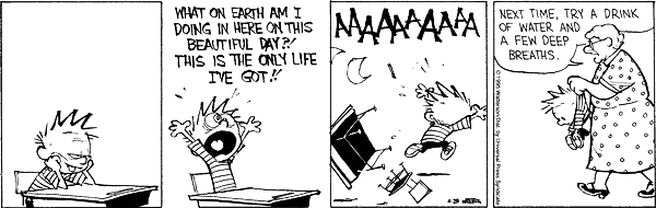 Calvin expresses that thought we've all had on a May day. Summer is so close...
School's Out - Now What? I'm the last person who is going to suggest you keep studying hard, all through summer, purely for fun. If you are attending summer school, that's entirely different. But for rising and graduating seniors, it's important to give your mind a break for a couple of months, before leaping back into the school year.
That said, there are a couple of things you can do during the summer to be prepared for fall deadlines. Rising Seniors RESEARCH COLLEGESThe summer is a great time to start researching which colleges you want to apply to in the fall. Think about what features are important to you in choosing a school, and make a list of schools that appear to meet your criteria. If your family's schedule and budget allows, try to visit at least two of the schools on your list. Sometimes just walking around a campus can help you discern whether or not the school is a good fit for you.SCHEDULE YOUR SAT/ACT TESTIt's better to take the SAT and / or ACT early in the year. If you are not satisfied with your results, you leave yourself time to take the exam again before applying to colleges.GET A JOB OR HOBBYIf you aren't already working or involved in some type of volunteer work or sport, you can take advantage of summer to add work, volunteer, or sports experience to your college application resume. Schools want well-rounded students, and applicants need to demonstrate that they have interests beyond the classroom.READ AND WRITEMake a goal to read 3 books (or 10 if you are already an avid reader) about anything. The books do not need to be academic. Just keep your mind active and engaged. Since you are going to have to prepare a college application essay in the fall, practice writing in the summer. Write anything - a journal, a blog, letters to your grandma. Anything. Graduating Seniors You are officially a high school graduate - congratulations! In today's world, however, the college degree is the new high school degree. Which means you still have an average of four more years ahead of you as a student. Definitely take time to celebrate your accomplishment with your friends and family, and enjoy your summer. There are a few things you can make time for now that will ease your transition to college life in the fall.
ARRANGE YOUR LIVING SITUATION
Most schools assist you in the process, requiring freshmen to live on campus. They try to match roommates based on a questionnaire about studying and sleep habits. If your school assigns you a room and a roommate, contact your future roommate(s) during the summer. If you introduce yourself early, there is the opportunity to arrive already friends (or at least friendly).
In the unlikely event your early correspondence with your roommate suggests it would be harmful or unsafe for you to live together, it is better to alert the school with a room change request now, instead of in the fall.
FIGURE OUT YOUR COURSES
The course catalog is online and you will have to sign up for classes in August. Get a sense of what programs you want to pursue, and the courses required for each. If you are really ambitious, you can always look up course syllabi from past semesters and start some of the reading over the summer. Email the professor to find out if there are any changes to the syllabus if you are worried about doing work for no reason.
FIND AN INTERNSHIP
Think you are interested in pursuing a Journalism degree? See if a local newspaper will let you intern for the summer, so you know if you want to make Journalism your major. Note that internships are not paid, so if you desperately need money...
GET A JOB
College is expensive. Even if your tuition is taken care of, you will still want extra cash for clothes, snacks, sports equipment, going to the movies, dates, and trips with your roommates. If you are paying your way through college, make getting a job top priority.
Take a Break, Read a Little, and Relax a Lot It's summer - enjoy it. But if you can implement even one of these tips, you will find yourself in a better position come fall to not be overwhelmed by additional tasks on top of your normal workload.
Not sure where to apply? I talk you through choosing colleges before you start the applications process. Save yourself a lot of time and money by doing your research and figuring out which schools are right for you based on:
Location: Close to family? Do you prefer an urban or rural setting? Can you survive a cold climate?
Size: How big is the school's campus and it's student body? What is the teacher to student ratio?
Cost: How much is tuition, plus room and board? Are there scholarships available?
***FILL OUT THE FAFSA!
Interests: How does the school serve your interests? Does it have the major you want and an active alumni network with a demonstrated record of placing graduates in jobs?
Finally - honor your preferences, interests, and abilities. I strongly suggest you think twice about applying and attending a school solely based on factors such as your parent went there, your significant other or best friend is going there, or your sibling is already attending.
Ultimately, you are the one going to class, taking the tests, and calling it home for the next four years. Make sure you choose a school you actually want to be at.
Any questions about how to research schools?
What factors are important to you, when deciding where to apply?
While it is definitely a good idea to have one or two people to proofread your resume, I would not suggest a resume-writing party. Even though it looks like they are having a great time. Photo: http://www.mticc.com For Students  Whether you are in high school or college, at some point you are going to need to write a resume. Do not just use a free template found online or through Microsoft Word. Your resume, like any piece of writing, must be tailored to the job you are applying for.
Some basic formatting guidelines include using classic fonts like Times New Roman or Arial in sizes 10-12, black and white only, printed on white or ivory quality resume paper. Although it seems counterintuitive for getting noticed, simple is better.
Basic Organization CONTACT INFORMATION
At the top, you need to state your full name and contact information, including mailing address, phone, and email.
OBJECTIVE
When you are applying for a specific job, and the hiring committee already knows exactly what position your resume is for, an objective is redundant. It is better to leave it off, and free up some room to detail your work experience.However, when posting your resume on a job site, or submitting it to a company or organization without a specific position opening, include an objective. Some people advise against including this, claiming it looks dull and "juvenile." I disagree. It is important to explicitly state what job you are applying for.
Objective: To obtain a position as an Office Assistant at Company X.EDUCATIONThen put your education history. Start with your most recent degree or certification. Include the name of the school, the specific degree and major, and the dates attended. WORK EXPERIENCEStarting with your most recent job, list your relevant work experience. Include your title, company or organization name, location, dates started and ended, and a bullet point or two outlining your major duties. You want to keep the resume to one page, so if you are waffling between which jobs to list, cut the ones that aren't pertinent to the position you are applying for. In other words, if you are applying to be a bank teller, mention that you worked as a customer service representative at a retail store but omit that you worked at a frozen yogurt shop.However, if there is a believable way to spin seemingly unrelated work experience into relevant past experience, go for it.SKILLSDo you speak a foreign language? Are you a computer genius? Refer back to the job description and highlight which of your skills fits the company's needs.REFERENCESHere list three past employers, their title, place of employment, and contact information. In some cases you can leave this off and the company will ask for them. Usually a job posting will state whether or not they want references listed. Do not write "References upon request." Putting It Together You will get conflicting advice about how to order the information I listed above. My order is intentional and strategic: you state what job you are applying for, your education, your work experience, and skills. A hiring manager is only going to skim the resume anyway; the resume should have a logical flow of information.
Whatever you do, don't lie or even overembellish. Do not put you are fluent in Japanese if you only know a few words or phrases. It's better to be up front about your abilities. Even if someone doesn't test you in the interview, you still might end up in a position that you are not, in fact, qualified for, and will be overwhelmed.
However, that doesn't mean you shouldn't try for positions that seem difficult to obtain. If you believe you are a good candidate and capable of doing excellent work, follow the guidelines I outlined and submit your resume with confidence.
For those already in the working world, I am working on a post that details how to improve your existing resume.
One final (and important!) note: for any student applying to graduate school, a professional resume is not the same as a Curriculum Vitae, or CV. A future post will cover how to write an academic CV.
 There are generally three different kinds of essay prompts given on college applications:
1. The deep philosophical question
2. The experiential question
3. The "Why do you want to go to our school?" question
The Philosophical Question Gary Gaffney, ’69MS, began doctoral work in mathematics at Notre Dame but left to become an artist, eventually earning two degrees in fine art. His poem “Mil Preguntas (a meditation in 1000 questions)” explores a myriad of topics, using queries both whimsical and profound. Some of our favorites are:
• What is consciousness?
• What is your deepest mystery?
• What’s the last honest question you asked yourself?
• How often has humanity led you to forgive?
• What makes you dream?
• Is being ordinary a failure?
• What can’t you live without?
• Who convinced you about God?
• Can you tell the story of faith put to the test?
• Why should you care about the rings of Saturn?
• What will you never believe?
• What will you always believe?
Provide your own answer to one of the author’s inquires and be sure to tell us which question you select.
Big question, right? The first place to start is to make sure you read and re-read the prompt, which tells us that the applicant only has to pick one of the sub-questions to write on. How to pick? This is actually pretty simple. Mindful Writing starts with a ten or fifteen minute brainstorming session, to see what your initial thoughts and reactions are. I guarantee you will find yourself reacting to one or two of the options. Make sure you write about yourself, your qualifications, and why you want to go to the specific school you are applying for, even as you attempt to answer the philosophical question. The Experiential Question These questions are aimed at the applicant's unique life experiences and are usually something along the lines of "Describe a time in your life when you overcame a challenge," or "What is your passion and how do you live it?"
If given a choice between philosophical or experiential questions, I advise students to pick the latter. In any essay you want to offer details about yourself, and it is easier to stay focused on that task when writing about your experience.
It is important to pick an experience that was meaningful or transformative for you. Do not write about something just because you think it is what selection committees want to hear. Examples of meaningful experiences range from dealing with illness or death, living abroad, winning or losing, creating something, a hobby or interest, or a relationship. The "Why Our School?" Question Warning - this is not the easiest question to pick. Here's why - you are probably applying to more than one school. You don't really love all of them equally. There are probably one or two you really hope to get accepted into, a few you wouldn't mind attending, and a couple of "safety" schools that are better than nothing.
If you are writing the essay for your top choice, it should not be too difficult. You can mention visiting the campus, what the university means to your family, or how its programs and resources would support your future aspirations.
If you are not writing for your top choice, you need to do some research on what the college offers and why it would be a good fit for you. Final Notes The Common Application offers choices from each of the three categories outlined above, as well as a "topic of your choice." Ultimately, you need to find a way to write about something that personalizes your application and makes you stand out to an admissions officer.
It's important to remember that there are many equally qualified applicants vying for a limited number of spots at the college of your choice. Not only do you need to write well, but also, you need to write strategically, to have an advantage over other students.*
Graduate school applications require a slightly different kind of strategy, which I will cover in an upcoming post.
*If you need help writing strategically for college admissions essays. contact me about working together. I can help a client get organized in terms of forming a list of schools to apply to, preparing application essays, and looking at available scholarships.
How many times have you attempted to write while checking Facebook, LOLCats, your email, and watching Parks and Rec? How is that working for you?
According to Professor David M. Levy of the University of Washington, the problem is not technology. Rather, we need to learn how to discipline our minds to be attentive in spite of technological distractions. This Chronicle of Higher Education article details how Professor Levy uses 15 minute meditation periods to help his students practice mindfulness. "So many of those debates fail to even acknowledge or realize that we can educate ourselves, even in the digital era, to be more attentive," he says.
This idea of mindfulness is also helpful for anyone struggling with a written assignment. The worst part is starting. Sometimes after you write your name, the date, page numbers, and the title, you end up staring a blinking cursor, waiting for inspiration to hit.
It won't.
The good news, however, is you do not have to rely on inspiration or divine intervention to get a paper written.
Unlike Professor Levy, I am suggesting a more active form of meditation prior to writing. Before you even sit down to work on a paper, take 15-30 minutes to review the assignment prompt and just start writing. Write anything that comes to mind, including bullet points, questions, and possible sources to check. Make sure to consider arguments and counter-arguments if you are expected to take a stance.
When time is up, review your initial response. Is there an argument in there? If so, it becomes your thesis. If not, turn to your questions. Use these as research prompts, to help you formulate your position. Look up the sources of interest before writing, since they will usually help you be specific and detailed in your paper.
Then you can sit down to start the paper. By now you have a mental roadmap of where your paper is heading.
Mindful writing requires two main steps for most of us:
1. Unplug from all distractions (even email!).
2. Devote a block of time to just thinking about the paper.
Mindful writing is not intuitive for most of us. We are busy and used to dividing our attention to several things at once. Give it a try, or contact me for further help. Writing can be efficient if you start with a rough outline. Then you can get back to "liking" your friend's vacation pictures on Facebook.
|


